There’s a lot to talk about in this article. His point, made in numerous of his posts, that Traveller was originally intended to have no published setting, always strikes home with me.
I have often said that when we (our group) was playing Traveller in highschool we didnt' know what we were doing. We didn’t know the rules. Our referee, who had an incredible imagination and ability to flow and improvise, didn’t seem to know the rules that well. And I’ve said that while we had fun with our games, the games probably weren’t that good.
I think I’ve changed my mind. I think that even with all our lack of whatever it was we lacked our game were actually great. Our referee was great. In my hubris I didn’t understand the he was using the rules exactly as they were intended.
By the time we started playing, the Third Imperium setting was certainly at least partially published. I don’t think we had any of those books. I might have had Research Station Gamma, but that was about it. We had the LBBs, Mercenary, and High Guard. And Citizens of the Imperium.
Our referee gamed with some older guys. In classic late 80s/early80s nerd style, one of those guys had created a computer program to randomly generate planets and create the star map. That’s what we used. That’s it. No lore. No Cannon. No bullshit.
Our characters flew around in their ship, visited multiple planets per game, got into trouble, caused trouble, and had fun. Once we all read some of the Well World books by Jack Chalker. We decided to seek out the Well World and get transformed into minotaur’s or mutants or whatever. It wasn’t in the rules but we did it anyway. One guy had a sword that was 1 molecule thick and could cut through nearly anything. That also was not in the rules, but again we did it anyway.
We, the players and the referee, filled in the science fiction blanks in the tech level charts and did the kind of SF we wanted to play.
I think the campaign I currently run is really good. I think it’s the best RPG campaign I’ve ever run ( think the same about our D&D 5e campaign that I run). It is really our campaign. The players add just as much to it. I just set the stage. I love it, and the idea of ever NOT running it simply doesn’t compute for me. I mean - to the point I want to live as long as possible just to keep the campaign going. But thinking about it in relation to my new understanding of our old games from high school, I’d like to channel a bit more of that youthful chaos into it. Those - were - good - games.
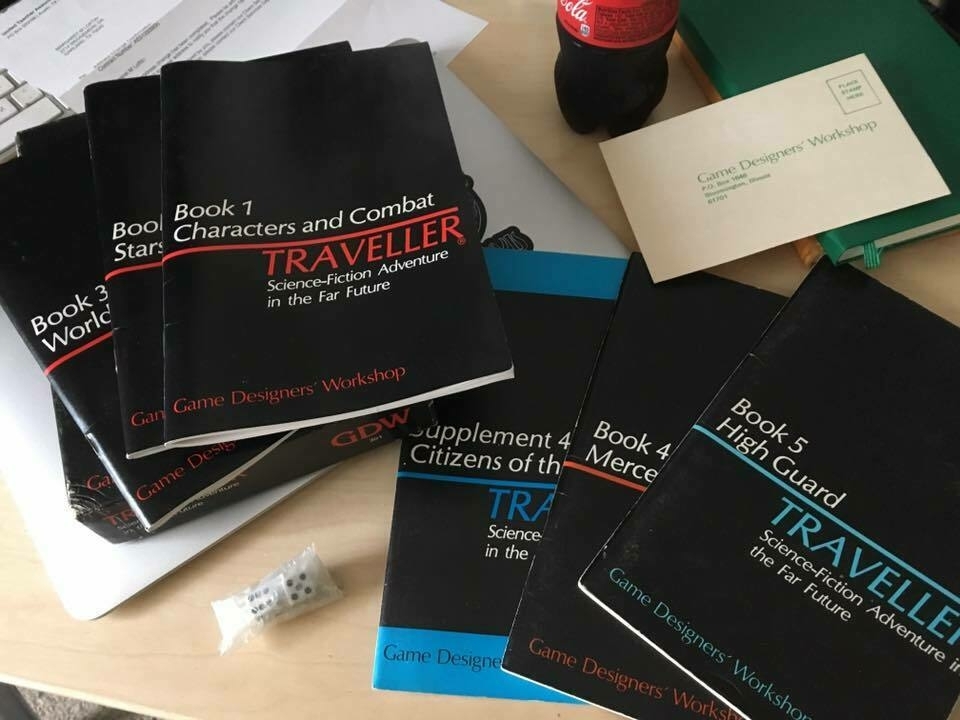
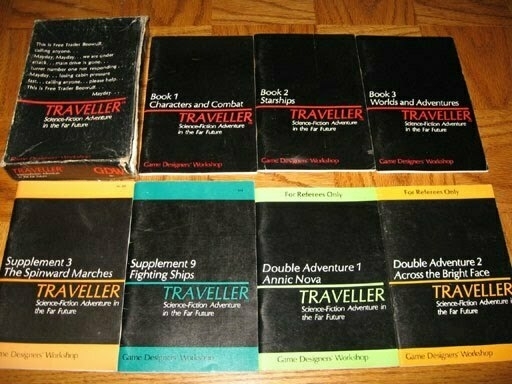
Well, thanks again to the Ebays, I now have the Traveller boxed set from 1979, as well as the High Guard, Citizens of the Imperium, Mercenary, and Spinward Marches supplements.
Of course the first thing I dug into was book 1, Characters and Combat.
The books are in amazingly good shape considering they are 38 years old.
It’s pretty weird going back into such an old gaming system. After many years of playing games that use point systems to create the character you want to play, Traveller seems like quite the throwback. The character generation process is a game in-itself — the PC can die before he/she gets out of generation! Then there’s situations like rolling up a character with a Strength of 12 (on a 1-12 scale), Dexterity of 12, and an Endurance of 4. It’s hard to make sense out of those sorts of stats, but you know, it can be done, and at age 52 (rather than 15), I can see the fun of doing it. How about, a big fat guy who is really strong, and has great hand eye coordination, but is just TOO HEAVY. That works! And it might make the character kind of interesting as well.
Then there’s the skills. This isn’t like GURPS where there are dozens of skills and you decide how good your character will be at them. There are fewers skills, but they tend to be a bit broader in focus. Medic. Pilot. Engineer. Gun Combat (pick a particular gun). Jack of All Trades (I’ve always loved this one). So you don’t have the really detailed differences in PC stats that you might seen in GURPS or the Hero System. It’s more on the player to create an interesting backstory and give the PC some personality.
Looking at all the books together, it’s pretty clear why our games back in 1979-1981 always involved going to a planet, buying new guns, killing a lot of people, running to another planet, and repeat. We were young, immature, and really didn’t know that much about science fiction, and frankly we didn’t really do that much real roleplaying. The boxed set give you such a flexible framework within which to build a game that we just didn’t know what to do with it.
Finally (for now), I have to admit that the lack of a very workable improvement system for characters still kind of puts me off a bit. On the bright side, it encourages good storytelling and roleplaying. However, it does kind of suck to go through a lot of games and your character doesn’t really improve. A PC has to age four years, during which he/she studies like a maniac, to learn new skills or improve at old ones. I’m sure some of the newer versions of Traveller probably address this issue. I could see using the GURPS version of Traveller, and using the old books as source material and inspiration.
I’m thinking that after our next GURPS CyberTex game I may have my players roll up some old Traveller characters and see what we can do with this.
I had the bug the other night, so I ordered an old boxed set of the Classic Traveller core books, plus some supplement, off of ebay. Looking forward to getting them and maybe running a game.
This is a repost of something I wrote several years ago as I was returning to Traveller, the greatest RPG even created.
As I think back over my early days of gaming and GMing, the memories are flooding back. When I started in 1979, there weren’t hundreds of RPGs. Most of the time my friends and I played D&D, but one guy had the game Traveller, so we played that too. Eventually we all bought the game.
Traveller was great because it was about space, and was really flexible. The basic set came in a box and had 3 little black books of rules. They sold a lot of supplements. I don’t think there was a single illustration in the core set. Something about the books made you feel smart.
The game mechanics had rules for spaceship combat, interstellar commerce, and other cool stuff, but at 15 we mostly just blew stuff up. Get in the spaceship, go to a planet, get drunk, find a weapons dealer, buy some plasma rifles, and start killing. When the Law got on our asses we’d hop in our ship, the Hellfire, and take off, usually destroying more people and ships on the way out of the system. Mass murder and mayhem on a glorious scale.
It helped that our GM 1)just wanted his friends to be happy and 2)didn’t seem to have actually read any of the rules beyond character generation. His answer to any question of skill was “roll two dice”. We had no idea what we were rolling for, and neither most likely did he, but we all had fun and that’s all that mattered. Clearly, we never got bogged down in game mechanics…heh heh.
Our GM got into gaming really early. Every Wednesday night he went to this huge gaming meetup at Richland Junior College, here in Dallas. He was friends with lots of older gamers. One of them was a computer programmer. He gave our GM this gigantic hex map, with planets dotting it. Each planet had a number, and there was a computer printout on which the characteristics of each planet were given — randomly generated by a program this guy had written. Pretty cool. We were in awe.
As we got older, and better game systems were released, we tended to gravitate toward the new stuff. Hero Games’ Champions was a prime example. Flexible, great combat system, etc. Game Designer’s Workshop, the authors of Traveller, have continued to release new editions of the game, but we never played them. We stuck to the original when we wanted hot space action. There was something really cool about that little box, with the 3 original books, and maybe having a couple of the supplemental books and a bunch of dice crammed in there. It was stripped down roleplaying. It was all on you and the GM.